
“Swampy” “A hot mess”
These are just a few of the ways teachers described what it was like trying to teach through last week’s extreme heat. Playgrounds turned into sun traps. Classrooms became greenhouses. Staff up and down the country found themselves trying to cope with conditions our schools simply weren’t built for.
You don’t need a child in school to feel this. If you’ve stepped outside in Greater Manchester this summer, you already know how hot our streets and spaces can get. Our towns and cities simply aren’t built for the heat they now regularly see.
Schools show this clearly because of the data is being collected on the ground. Teacher Tapp, England’s largest daily teacher survey, found that 63% of schools moved break and lunch indoors last week, and 81% kept students in whatever shade they could find (1).
But keeping kids indoors isn’t a neutral trade-off. Outdoor time during the school day gives children a genuine break from the classroom, which helps them settle and focus once they’re back at their desks. Cooped-up kids on a hot day tend to get restless and irritable rather than calm. Losing that time doesn’t just mean a duller lunch break, it can mean a harder afternoon for everyone. Shade isn’t a luxury add-on to the school day, it’s what lets outdoor time happen safely.
Why our playgrounds get so hot?
Much of this comes down to what our school grounds are made of. Astroturf, asphalt and rubber crumb might be low maintenance, but they absorb and radiate heat, turning already warm days into something far more intense.
Trees can do the opposite. They provide shade which reduces how much heat these surfaces soak up in the first place. Trees also cool the air around them through evapotranspiration – releasing water vapour that takes the edge off a hot day. It’s the same effect we see cooling city streets. Beyond this, trees have benefits for children’s wellbeing, improving air quality, enhancing biodiversity and providing opportunities for outdoor learning.
What are we doing about it?
This isn’t a problem we’re only just noticing. We use spatial data to identify the school grounds most in need, mapping heat exposure, tree cover and levels of inequality to work out where planting will make the biggest difference. You can read more about how we do this in our Urban Forest Plan (2).
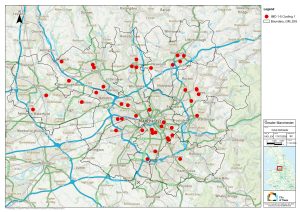
Using this approach, we’ve already planted 6.45 hectares of trees across 45 schools flagged as priorities for cooling (Map 1), and since 2021 we’ve planted 14 hectares in schools serving communities with an IMD score of 1–5, in plainer terms, some of the most deprived areas in Greater Manchester.
Why does this matter?
Research led by environmental social scientist, Lewis Winks, featured in the Guardian last week (3), found that private school grounds in England have 41% more tree cover than state schools. Shade shouldn’t depend on the kind of school a child goes to and closing that gap is exactly the work we’re focused on.
Policy guidance points the same way, trees aren’t a nice to have, they’re part of how our schools adapt. The Department for Education is encouraging schools to plant more trees as this heatwave continues, and the Joint Union Heatwave Protocol (4) specifically recommends tree planting around school grounds as a way to help mitigate the effects of extreme heat.
What you can do?
Establishing a tree canopy that can genuinely cool a playground takes time, but every tree planted brings a school one step closer to being ready for the summers ahead. Remember, if you choose to work with City of Trees schools pay nothing. If you school grounds are appropriate, we provide the free trees, tools, equipment and expertise. Our team will host a tree planting day with the children and long-term maintenance plans will be put in place.
- Are you a teacher or headteacher in Greater Manchester? It costs your school nothing. Get in touch here.
- Are you a parent? Know a school that should be doing this? Share this with your child’s teacher, headteacher, or PTA.
For any further questions, please visit our website or contact our schools team at schools@cityoftrees.org.uk.